
Most companies think hiring developers is simple.
You post a job opening, interview candidates, offer a salary, and start building products.
But in 2026, the reality is very different.
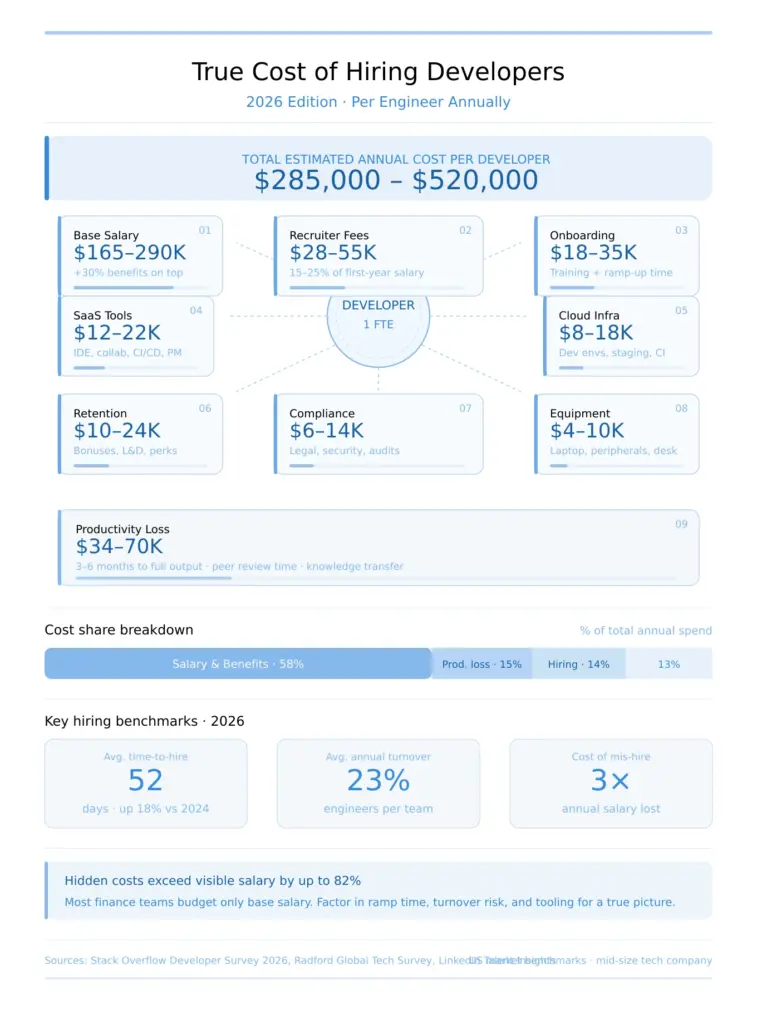
The hidden costs of hiring developers often become much larger than the salary itself. Recruitment operations, onboarding, infrastructure, compliance, retention, and productivity losses can dramatically increase the real budget required to scale an engineering team.
For startups and growing businesses, these unexpected expenses can slow growth, delay product launches, and create financial pressure.
According to the World Economic Forum, the global shortage of tech talent continues to increase, making developer hiring more competitive and expensive worldwide.
At the same time, companies are investing more in remote infrastructure, cybersecurity, AI development tools, and global hiring operations.
This means businesses must understand the true cost of developers before scaling technical teams in 2026.
In this guide, we’ll break down the biggest developer hiring expenses, explain why companies underestimate tech recruitment costs, and show practical ways to reduce hiring risks while building strong engineering teams.
Why Developer Hiring Became More Expensive in 2026
The software hiring market has changed significantly over the last few years.
Remote work opened access to global talent, but it also created international competition for experienced developers.
Today, startups in the United States compete with companies from Europe, Asia, and the Middle East for the same engineers.
This increased:
-
- Salary expectations
-
- Recruitment timelines
-
- Retention costs
-
- Hiring competition
-
- Infrastructure spending
- Compliance requirements
According to LinkedIn Talent Solutions, technical positions now take considerably longer to fill compared to non-technical roles.
At the same time, the Stack Overflow Developer Survey shows that developers increasingly prioritize flexibility, remote work, growth opportunities, and engineering culture in addition to salary.
As a result, businesses must invest far more than compensation alone to attract and retain high-quality developers.
The Biggest Hidden Costs of Hiring Developers
1. Recruitment and Sourcing Costs
One of the first hidden expenses appears before the developer even joins your company.
Finding qualified engineers requires significant investment in recruitment infrastructure.
Companies often spend money on:
-
- Job board subscriptions
-
- Recruitment software
-
- HR operations
-
- Technical interviewers
-
- Employer branding campaigns
-
- Paid ads
-
- Recruitment agencies
-
- Internal hiring management
Many businesses underestimate how expensive technical recruitment becomes when positions remain open for months.
According to reports from Glassdoor and Indeed, engineering roles typically require more interview rounds and longer hiring cycles than most other positions.
If companies work with external recruiters, fees can range between 15% and 30% of a developer’s annual salary.
Estimated Recruitment Costs
| Hiring Expense | Average Cost |
|---|---|
| Job platforms | $500–$3,000/year |
| Recruitment tools | $200–$1,500/month |
| Recruiter fees | 15–30% of salary |
| Employer branding | $1,000–$10,000+ |
| Internal interview time | Operational expense |
This is one reason many companies now explore staff augmentation and global hiring strategies.
You can also read Yoocollab’s guide on how companies scale tech teams faster with staff augmentation.
2. Onboarding and Training Costs
Hiring developers is only the beginning.
New engineers require onboarding, access setup, internal training, documentation reviews, and team integration before becoming fully productive.
In 2026, onboarding became even more expensive because distributed teams work across multiple countries and time zones.
Typical onboarding includes:
-
- HR onboarding
-
- Device setup
-
- Security access
-
- Internal systems configuration
-
- Product training
-
- Team introductions
-
- Workflow education
-
- Technical environment setup
According to Harvard Business Review, poor onboarding directly impacts productivity and employee retention.
Many developers need several weeks or months before reaching full performance.
This creates a hidden productivity gap companies often ignore during budgeting.
Additional onboarding expenses include:
-
- Laptops and hardware
-
- SaaS subscriptions
-
- Cloud access
-
- Security tools
-
- Mentorship time
-
- Productivity losses
When startups hire multiple developers simultaneously, onboarding costs can grow rapidly.
3. Infrastructure and Software Expenses
Modern engineering teams depend on expensive technical ecosystems.
The true cost of developers now includes infrastructure, collaboration tools, cloud systems, and security platforms.
Typical engineering tools include:
| Tool Category | Examples |
|---|---|
| Project Management | Jira, ClickUp, Linear |
| Communication | Slack, Teams |
| Code Repositories | GitHub, GitLab |
| Cloud Platforms | AWS, Azure, Google Cloud |
| Security Tools | Okta, CrowdStrike |
| Documentation | Notion, Confluence |
According to infrastructure research from Flexera, cloud spending continues growing globally as companies rely more heavily on distributed development operations.
Companies scaling engineering teams quickly often underestimate recurring infrastructure costs.
In 2026, even AI coding assistants and productivity platforms became part of standard developer environments.
4. Retention and Turnover Costs
Replacing developers is extremely expensive.
One of the largest hidden costs of hiring developers is employee turnover.
When engineers leave, companies lose:
-
- Product knowledge
-
- Development speed
-
- Team stability
-
- Technical expertise
-
- Documentation continuity
-
- Delivery momentum
At the same time, recruitment must start again from the beginning.
According to workplace research from Gallup, employee turnover creates major operational and financial pressure for businesses.
Turnover costs often include:
-
- New recruitment expenses
-
- Lost productivity
-
- Delayed releases
-
- Additional onboarding
-
- Increased management workload
-
- Knowledge transfer gaps
In today’s market, developers frequently receive multiple job offers.
This is why companies increasingly invest in:
-
- Flexible work models
-
- Career development
-
- Learning budgets
-
- Better engineering culture
-
- International opportunities
-
- Work-life balance
Retention became one of the most important factors in controlling long-term developer hiring expenses.
5. Productivity Loss From Slow Hiring
An unfilled engineering position is also expensive.
When businesses fail to hire developers quickly, projects slow down.
This can lead to:
-
- Delayed product launches
-
- Slower feature development
-
- Revenue loss
-
- Team burnout
-
- Missed opportunities
-
- Increased pressure on existing teams
According to McKinsey, companies with faster hiring processes often outperform competitors in innovation and delivery speed.
In 2026, hiring speed directly impacts growth.
For startups especially, delayed engineering hires can affect investor expectations and product roadmaps.
6. Global Compliance and Legal Expenses
Remote hiring created access to global talent, but it also introduced new legal complexities.
Companies hiring developers internationally may need to manage:
-
- International contracts
-
- Payroll compliance
-
- Tax regulations
-
- Labor laws
-
- Intellectual property protection
-
- Security compliance
-
- Data privacy regulations
These operational responsibilities create additional overhead that many startups underestimate.
For businesses scaling globally, working with trusted outstaffing partners often simplifies compliance and reduces administrative complexity.
7. The Cost of Bad Technical Hires
A poor engineering hire can become extremely expensive.
When companies rush recruitment or fail to evaluate developers correctly, the result may include:
-
- Poor code quality
-
- Missed deadlines
-
- Security risks
-
- Team conflicts
-
- Product instability
-
- Increased QA costs
-
- Expensive rebuilds later
According to research from SHRM, hiring mistakes can cost companies thousands of dollars depending on the role.
Technical hiring requires careful evaluation of:
-
- Coding ability
-
- Communication skills
-
- Product thinking
-
- Team collaboration
-
- Long-term compatibility
This is why structured technical recruitment became essential in 2026.
Average Cost of Hiring Developers in 2026
The cost of hiring developers in 2026 varies significantly depending on region, experience, and hiring model.
| Region | Average Annual Cost |
|---|---|
| United States | $120,000–$220,000+ |
| Western Europe | $90,000–$170,000 |
| Eastern Europe | $45,000–$90,000 |
| Latin America | $35,000–$80,000 |
| Asia | $25,000–$70,000 |
These numbers often exclude:
-
- Recruitment costs
-
- Benefits
-
- Taxes
-
- Equipment
-
- Infrastructure
-
- Retention spending
-
- Operational overhead
This is why many startups compare in-house hiring with staff augmentation models.
You can also explore Yoocollab’s comparison of staff augmentation vs in-house hiring.
How to Reduce Developer Hiring Expenses
Build a Faster Hiring Process
Long hiring cycles increase costs significantly.
Companies should simplify:
-
- Interview stages
-
- Technical assessments
-
- Internal approvals
-
- Communication workflows
Faster hiring improves candidate experience and reduces operational overhead.
Invest in Retention Early
Keeping developers is often cheaper than replacing them.
Focus on:
-
- Career growth
-
- Strong communication
-
- Flexible work
-
- Engineering culture
-
- Learning opportunities
Strong retention strategies reduce turnover-related recruitment costs.
Use Staff Augmentation Strategically
Many startups reduce hidden hiring costs through staff augmentation.
Instead of managing recruitment, onboarding, infrastructure, and compliance internally, businesses gain access to pre-vetted developers through external partners.
Benefits include:
-
- Faster hiring
-
- Flexible scaling
-
- Reduced operational overhead
-
- Lower recruitment costs
-
- Access to global talent
-
- Simplified administration
This approach became increasingly popular among SaaS companies and scaling startups.
You can also read Yoocollab’s guide about the cost of staff augmentation in 2026.
Hire Globally Instead of Locally Only
Remote hiring allows companies to access experienced developers in more cost-efficient markets.
Many businesses now scale teams across:
-
- Eastern Europe
-
- Armenia
-
- Latin America
-
- Asia
This reduces:
-
- Salary pressure
-
- Office expenses
-
- Recruitment competition
-
- Hiring timelines
At the same time, businesses maintain access to strong technical talent.
You can also explore Yoocollab’s article about the best countries to hire developers in 2026.
In-House Hiring vs Staff Augmentation
| Factor | In-House Hiring | Staff Augmentation |
|---|---|---|
| Recruitment | Internal responsibility | Managed externally |
| Hiring Speed | Slower | Faster |
| Infrastructure | Internal setup | Often included |
| Compliance | Complex | Simplified |
| Scalability | Limited | Flexible |
| Operational Overhead | Higher | Lower |
For many startups, hybrid hiring models now provide the best balance between flexibility, scalability, and cost efficiency.
Future Hiring Trends in 2026
Several trends continue reshaping technical recruitment.
AI-Assisted Hiring
Companies increasingly use AI to:
-
- Screen candidates
-
- Analyze resumes
-
- Improve hiring speed
-
- Reduce HR workload
Distributed Engineering Teams
Remote-first development structures continue becoming standard globally.
Companies now prioritize talent access over office location.
Flexible Scaling Models
Staff augmentation and dedicated development teams continue growing because businesses need flexible scaling during uncertain market conditions.
Developer Experience Becomes Critical
Engineering culture, onboarding quality, and developer satisfaction now directly impact retention and productivity.
Companies investing in developer experience often reduce long-term hiring costs significantly.
Conclusion:
The hidden costs of hiring developers in 2026 go far beyond salaries.
Recruitment operations, onboarding, infrastructure, retention, compliance, and productivity losses all impact the real cost of scaling engineering teams.
Businesses that understand these hidden expenses early make smarter hiring decisions, scale faster, and reduce operational risks.
For startups and growing companies, flexible hiring models like staff augmentation and global remote teams often provide a more scalable and cost-efficient solution.
At Yoocollab, we help businesses build reliable development teams through outstaffing and outsourcing solutions tailored to modern scaling needs.
Whether you need remote developers, dedicated teams, or flexible staff augmentation, our team helps you reduce hiring complexity while accelerating growth.